
The Dye Pot
The Craft / Hand-Dyeing
Dyeing cloth and fiber is one of the oldest acts of transformation we know of. Long before yarn existed in the modern sense, people were boiling roots and crushing berries into cloth, chasing colors that held the eye and marked the body. The earliest direct evidence of plant-based dyeing reaches back to the Indus Valley civilization, around 2500 BCE, where cotton dyed with madder was found preserved at Mohenjo-daro. Woad, that stubborn blue favored by Celts and Roman observers alike, was being cultivated in northern Europe before the common era. To dye something was not just to change its color. It was to fix it, to make it hold, to commit the fiber to a particular state.
The chemistry of dyeing, understood now in molecular terms, was once understood in observational ones: certain things held color, others shed it after the first wash, and a third set transformed unpredictably in the pot. Mordants, the mineral salts that bind dye to fiber, were discovered empirically over generations. Alum, iron, copper, tannin. Each changes not just the fastness of the color but the color itself: the same madder root gives coral over alum, deep brick over iron, and something almost purple over tin. The dyer's art was as much chemistry as intuition, and it accumulated slowly through generations of hands at the pot.
The Chemistry, Without the Mystification
Modern hand-dyers primarily work with two categories of dye: acid dyes and natural dyes.
Acid dyes are synthetic, developed in the mid-nineteenth century after William Henry Perkin accidentally synthesized mauve in 1856 while attempting to make quinine. What followed was a revolution in color. Acid dyes bond to protein fibers, primarily wool, silk, and other animal-derived materials, through an ionic bond that requires an acidic environment to form. In practice, this means a fiber bath acidified with citric acid or white vinegar, heat to open the fiber's scales, and dye molecules that migrate into the cortex of the fiber itself. When it works correctly, the color doesn't sit on the fiber; it lives inside it. Acid dyes are reliable, highly saturated, and allow for the kind of color mixing and layering that would have been impossible before the synthetic era.
Natural dyes draw from plants, insects, fungi, and minerals. Madder root, weld, indigo, black walnut hulls, woad, cochineal (the crushed body of a scale insect that gives brilliant red and pink), iron-rich earth, pomegranate rind for tannin-rich tans and golds. Natural dyes behave differently than synthetics: they're less saturated in most cases, subject to shift with pH and light, and require careful mordanting to hold at all. The results tend toward the particular: colors that look different in different lights, that have depth synthetic dyes rarely replicate, that shift as the fiber ages. The tradeoff for that complexity is unpredictability.
What separates hand-dyed yarn from commercial yarn is neither dye type nor process specifically. It's that every skein moves through the bath differently. When a yarn is dyed industrially, thousands of meters move through a continuous process engineered for uniformity. When a skein is dyed by hand, it moves, folds, and sits in the bath in a way that's repeatable in pattern but never exactly the same. The color blooms and pools differently from skein to skein. What looks like inconsistency is actually each skein recording the specific story of its time in the pot.
The Mordanting Step
Before dye can bond to most natural fibers, the fiber needs a mordant. The word comes from the Latin mordere, to bite. A mordant creates a chemical bridge between dye molecule and fiber. Without it, most natural dyes will rinse out, or fade to near-nothing within a year of light exposure.
Alum (potassium aluminum sulfate) is the most common mordant in modern use: mild on fiber, true to color, easy to obtain. Iron (ferrous sulfate) is a modifier as much as a mordant, shifting colors toward green and grey, dulling brights, aging yellows. Copper gives greens and blue-greens, particularly with yellow dyes. Tannin, present in oak galls, sumac leaves, and black tea, works as a mordant for plant fibers that lack the protein structure that alum requires.
Acid dyes don't technically require a traditional mordant, but the acidic bath plays an analogous role: it creates the conditions under which the dye can form its ionic bond with the fiber. The chemistry differs, but the principle is the same. You are making the fiber ready to receive.
What Hand-Dyeing Does to Wool
When wool fiber is submerged in hot, acidic water, its scales open. This is what allows dye to penetrate to the cortex. It's also what can felt the fiber if the temperature is raised or dropped too rapidly, or if the skein is agitated while the scales are open. The dyer's hand in the pot is calibrating two things simultaneously: heat and movement, both of which must be managed gently.
The same scour and heat that opens the fiber to dye will also relax any spin tension built into the yarn during spinning. This is part of why hand-dyed yarn often looks a little more relaxed on the skein than commercial yarn, and why some skeins bloom considerably when they go into your first wash. The structure was set in the dye pot.
Some colorways involve multiple dye baths, each adding a layer of color. Others are hand-painted directly onto wet fiber laid flat, using pipettes or squeeze bottles, achieving sharp color transitions or gradients that couldn't be produced in an immersion bath. The techniques affect not just appearance but behavior: a yarn that was painted in distinct sections will behave very differently in a project than one that was immersion-dyed in a gradual shift. For more on how to work with those differences, see Working with Hand-Dyed Yarn.
The Transformation Argument
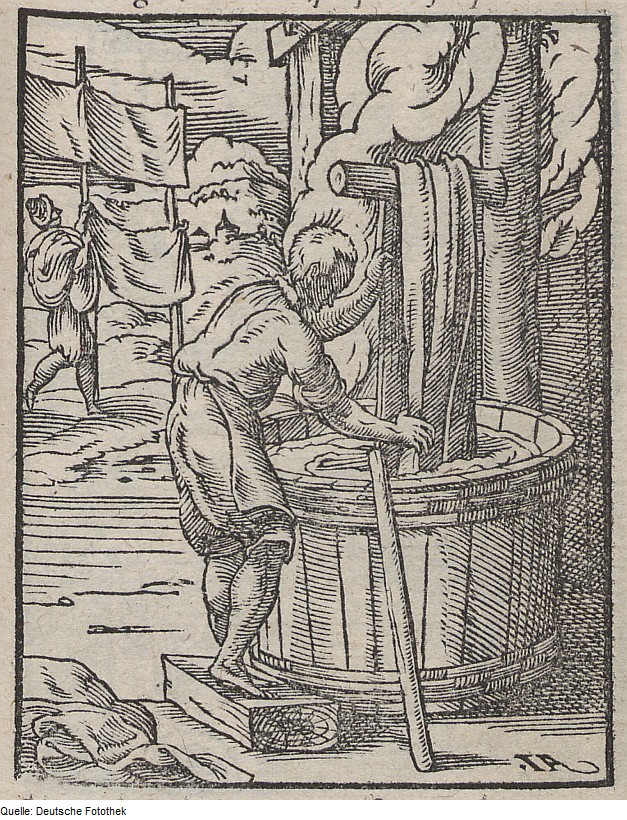
There's a reason the dye pot appears, again and again, in the mythology of transformation. Think of Ceridwen's cauldron in Welsh tradition, the cauldron of Dagda, the black pot in every grandmother's hearth story. The pot takes something in, applies heat, adds an outside agent, and returns something changed. The fiber that went in as raw cream-colored wool comes out as something it was not. The transformation is chemical; it is also actual.
At Arachne Fiberworks, every colorway begins here, at the pot. The color names aren't chosen after the fact. They're chosen in the dyeing, when a particular combination of dye, mordant, and fiber produces something that has its own gravity. The name is the recognition: this is what this color is. For more on the stories behind specific colorways, the Grimoire goes deeper into the mythology of each one.
Continue reading: Fiber & Its Properties · Working with Hand-Dyed Yarn · Blocking & Finishing