
The Loom
The Practice / Weaving Ritual
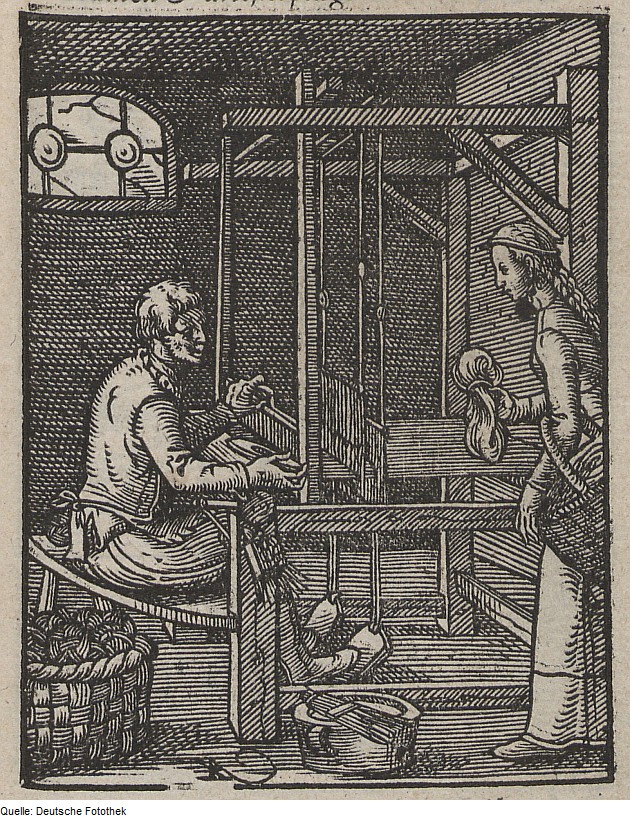
Weaving is the oldest textile technology with a clear archaeological record. Loom weights from the Neolithic period survive in sites across Europe, the Near East, and Asia, and impressions of woven fabric in clay have been found at sites dated to 8,000 BCE. The loom itself, in its most essential form, is simply a way of holding threads under tension so that other threads can be passed between them. But in the mythologies that grew up around it, the loom became something much larger: the mechanism by which fate was woven, time was structured, and the world was held together.
The Loom in Myth
The Norns weave at the roots of Yggdrasil, the world tree. Their work is not metaphorical. In the Norse cosmological frame, the structure of fate is literally woven: the threads are the lives of specific people and of the world itself, and the Norns' work at the loom determines what will occur. Urðr (what was), Verðandi (what is becoming), and Skuld (what shall be) are the three names, and together they make the structure of time.
The Greek Moirae perform a nearly identical function: Clotho spins the thread of life, Lachesis measures its length, Atropos cuts it. These are presented as older than the Olympians, more fundamental than the gods of the Greek pantheon, because fate is more fundamental than divine will. Even Zeus is subject to the Moirae in some versions of the tradition.
Arachne's contest with Athena is perhaps the most complex of the weaving myths, and the one whose resonance runs deepest in this brand's mythology. Ovid's Metamorphoses gives us the fullest surviving version: Arachne, a mortal weaver of Lydia, challenges Athena and produces a tapestry of equal or superior quality. Athena's tapestry depicts the gods in their power and majesty. Arachne's depicts the gods in their violations, their abuses, their deceits. The content of Arachne's weaving is not inferior craftsmanship; it is true. The punishment for telling the truth beautifully is transformation. Arachne becomes the spider, and the web she spins endlessly is both punishment and continuation of what she was.
Penelope's weaving in the Odyssey is a different kind of power: not a challenge to divine authority but a manipulation of human time. She weaves the funeral shroud of Laertes by day and unravels it by night, suspending the political pressure of her suitors in an endless unresolvable present. The loom here is a time machine, and Penelope its operator.
The valkyrie war-weaving described in Darraðarljóð, the Njáls Saga poem, depicts the valkyries at a loom with entrails for weft and severed heads for weights, weaving the outcome of a battle. The imagery is deliberately extreme, but it expresses the same logic: the structure of what happens is woven before it occurs, and the weavers have control.
The Loom as Sacred Object
In folk traditions across Europe, the loom carried protective and sacred associations. Breaking a loom thread was an evil omen in some traditions. The loom was sometimes kept from sight during critical moments: you didn't let strangers see a loom with work in progress, because the work could be interfered with through the loom. In some Scottish Gaelic tradition, the first shot from a loom (the first item woven on a new loom) had particular virtue as a protective object.
The shuttle, the device that carries the weft thread back and forth, appears in some folk charm traditions as a protective object in its own right, associated with movement between states and the carrying of power. The rhythm of the loom, the regular alternation of the heddle lifting and lowering, the beat of the beater pressing the weft, was itself sometimes understood as a kind of incantation through repetition.
Tablet Weaving for Ritual Use
Tablet weaving (also called card weaving) is one of the oldest weaving techniques with a clear archaeological record, and it's accessible without a full loom. Small cards with holes punched at the corners hold warp threads; rotating the cards in specific sequences creates patterns. Tablet-woven bands have been found in archaeological contexts from Viking Age Scandinavia to Iron Age Britain to ancient Egypt.
For magical work, tablet weaving allows you to weave specific color patterns into a band. A protection band might be woven in black and red using patterns from historical sources. A band woven in specific colors during specific planetary hours carries the timing of that work into the structure of the weave.
The technique is learnable from a standing start in a single afternoon session, particularly for simple patterns. The basic requirement is a set of cards (which can be made from cardboard), a warp thread of appropriate fiber, and a weft thread. The University of Nebraska has an online resource for pattern research, and the research of Peter Collingwood (The Techniques of Tablet Weaving, 1982) is the standard reference.
Beginning Work with a Loom
A rigid heddle loom is the gentlest entry point into weaving: it holds the warp threads under tension, manages the two sheds (the alternating paths for the weft), and allows you to weave reasonably quickly once the warp is set up. Rigid heddle looms are available at most major yarn shops and through online retailers.
Floor looms offer more complexity and control but require more significant setup and investment. The floor loom that allows for multiple shaft patterns and the full range of traditional weave structures is a commitment; the rigid heddle is sufficient for a very wide range of textile work, including intentional weaving for ritual purposes.
For spinning your own warp threads, which is a particularly rich practice in the context of intentional weaving, see Spinning Intent.
Sources
- The Story of Burnt Njal — Dasent’s translation; the valkyries’ weaving song, Darraðarljóð, is in chapter 157.
- Ovid, Metamorphoses, book VI — the contest between Arachne and Minerva, at the Perseus Digital Library, Tufts.
- Homer, Odyssey — Penelope’s web, woven by day and unpicked by night, at Perseus.
- The Elder Edda — the Norns at the roots of the tree, in English.
Continue reading: Spinning Intent · Thread as Intention · The Loom and Arachne