
Imbolc
The Wheel / February 1
Imbolc arrives when the light is returning but has not yet returned, when the ground is still cold but something under it is beginning to stir. The name comes from the Old Irish imb-fholc, meaning "in the belly," a reference to the pregnancy of ewes, whose lambs would soon arrive, and whose milk would make Imbolc the first point at which fresh food was again available after the stored provisions of winter. The season turns before it looks like it has turned. That is the essential Imbolc.
The feast is associated above all with Brigid, one of the most significant goddesses in the Irish tradition and one of the few whose cult survived Christianization with enough force to generate a saint of the same name, celebrated on the same day. The goddess Brigid is associated with fire (the smith's forge, the healer's lamp, the poet's inspiration), with wells and springs (the emergence of hidden water from underground), and with the domestic arts including weaving. The saint Brigid's cross, a woven rush or straw cross made fresh each year on February 1, is a continuation of the goddess's fiber connection in folk practice.
The crosses were woven and placed in homes and barns to protect through the coming year. The previous year's cross was burned, ceremonially releasing the old protection, and a new one took its place. The making of the cross is a domestic protective magic translated into Christian idiom, and in rural Ireland it remained a living practice well into the 20th century.
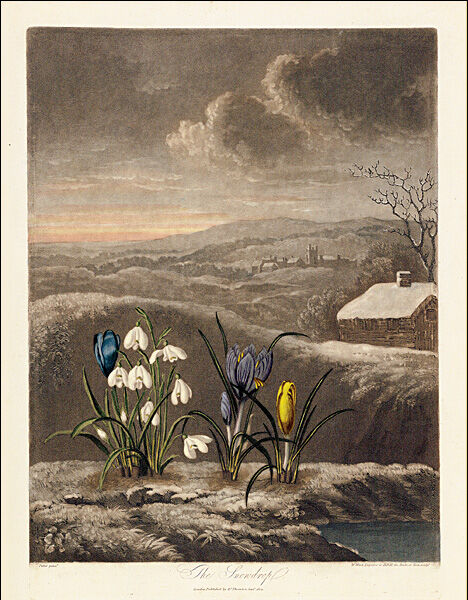
Imbolc is a quickening rather than a flowering. It asks for attention to what is barely beginning, for the recognition of potential before it is visible. The snowdrop is its characteristic flower not because February is warm but because the snowdrop blooms under snow, insisting on its existence before the earth has softened.
Correspondences
| Date | February 1-2 |
| Colors | White, silver, pale yellow, pale blue |
| Herbs | Snowdrop, blackberry, angelica, basil, bay, heather |
| Crystals | Amethyst, bloodstone, garnet, turquoise, citrine |
| Element | Fire (Brigid's forge) / Earth (stirring) |
| Planet | Sun (growing) |
| Intentions | New beginnings, purification, first stirring, creative fire, healing |
| Fiber | White wool for purity and new beginning; pale yellow for the returning sun; silver for Brigid's well |
| Knot count | 3 (new beginnings, manifestation) |
Traditional Workings
Making Brigid's cross: Even if you work in fiber rather than rushes, the principle translates. A cross woven from white or pale yarn on Imbolc carries the same protective intent as the traditional rush cross. Make it simply, bless it as you work, and place it in the home.
Purification: Imbolc is traditionally a time for cleaning, both practically and ritually. The practice of cleaning the home thoroughly at the year's first stirring is preserved in spring cleaning customs, though the original date was February rather than March. Light a white candle, sweep the home from back to front (moving what is old and accumulated toward the door and out), and set the space for what you want to grow through the coming months.
Lighting Brigid's flame: In Kildare, the fire at Brigid's shrine was said to have burned continuously for centuries. The eternal flame, tended by the nuns of Kildare's monastery, was extinguished by the Archbishop of Dublin in 1220 and reportedly relit in 1993 by the Brigidine sisters. Lighting a candle on Imbolc eve and tending it through the night is a continuation of this tradition at the personal scale.
Well dressing: If you have access to a spring, stream, or even a decorative fountain, offering flowers and ribbons to a water source on Imbolc connects to the tradition of honoring Brigid's wells. Wells in Ireland were dressed with strips of cloth tied to nearby trees, clooties or clouties, and the well was prayed over for healing. The ribbons left on the tree were understood to carry the petitioner's intentions.
Notes for the Dye Pot
Imbolc is the palest moment on the wheel. White, near-white, the faint yellow of winter sun through cloud. Silver for the well, the flash of water under ice. If you're dyeing for Imbolc, you're working with gentle saturation: a small amount of yellow dye producing warmth without brightness, a touch of blue in white producing silver-grey. The paleness isn't failure of color; it's the right temperature of this season.
Closing
Imbolc asks patience. The fire is lit again; the seeds are stirring; but the snow hasn't melted and the field isn't ready. Brigid's work is fire-tending: the slow keeping of something alive long enough for it to be of use. Between Imbolc and Ostara, that is the work.
Sources
- Carmichael, Carmina Gadelica, vol. 1 — the Gaelic hymns and invocations collected in the Hebrides, including the Bride material.
- The Schools’ Collection — how the cross was actually made, hung, and burned, in the words of the households that did it.
- The CELT corpus — the medieval Irish Brigid literature in edition and translation, University College Cork.
Continue reading: Ostara · Yule · Color Correspondences · Elemental Correspondences