
Lughnasadh
The Wheel / August 1
Lughnasadh (pronounced LOO-nuh-suh in Irish) is the first of three harvest festivals on the wheel, and it is the festival of the god Lugh, the long-armed, the master of all skills. In the Irish mythological tradition, Lugh established the feast in honor of his foster mother Tailtiu, who died of exhaustion after clearing the forests of Ireland to make way for agricultural land. Lughnasadh was therefore from the beginning a festival of labor, of the cost of making, and of the skill required to bring a harvest in.
The historical Lughnasadh was one of the four great Irish seasonal festivals and was associated with athletic games, legal assemblies, and the first tasting of the new harvest's goods, particularly berries. The feast at Teltown (a corruption of Tailtiu) was one of the most significant gatherings in early medieval Ireland, comparable in scale and social importance to the Norse thing assemblies. Marriages were contracted at Lughnasadh, specifically trial marriages that could be dissolved the following year if they didn't suit.
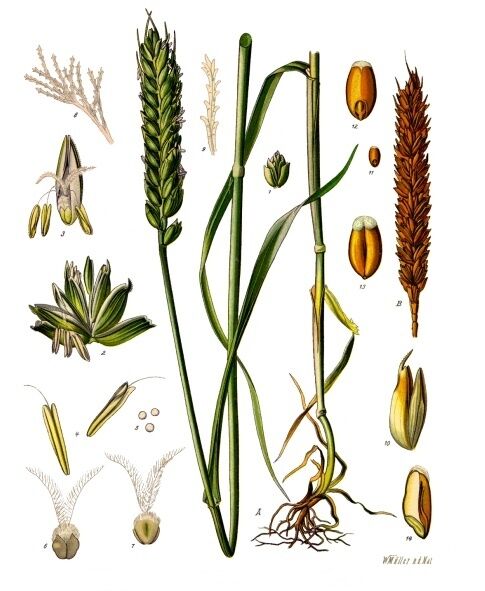
The grain harvest is Lughnasadh's primary agricultural correspondence. In many parts of northern and western Europe, the grain harvest was accompanied by ritual that acknowledged the cost of it: the last sheaf was cut with ceremony and the grain spirit it was thought to contain was honored, appeased, or preserved through the winter in the form of the corn dolly or maiden. Cutting the last sheaf was often done collaboratively, with all the reapers throwing their sickles at once so that no single person could be said to have killed the grain spirit. The corn dolly (woven from that last sheaf) preserved the spirit through winter and was plowed back into the first furrow at Imbolc.
This is the tradition that runs directly into the fiber magical practice of the corn dolly and the woven figure. See Thread as Intention for more on fiber figures as ritual objects.
Correspondences
| Date | August 1 |
| Colors | Gold, amber, brown, burnt orange, dark yellow |
| Herbs | Grain (wheat, barley), bilberry, heather, meadowsweet, sunflower, cornflower |
| Crystals | Tiger's eye, carnelian, citrine, topaz, moss agate |
| Element | Earth |
| Planet | Sun (waning), Lugh |
| Intentions | First harvest, gratitude, skill and craft, sacrifice, community, the cost of making |
| Fiber | Gold and amber for the grain; dark earth tones for the harvested field; brown for the threshing floor |
| Knot count | 7 (completion of a cycle, the harvest brought in) |
Traditional Workings
First fruits offering: Take the first produce of whatever you're growing, or purchase the first-of-season grain-based products (fresh bread, first harvest honey, early apples), and offer them intentionally. Set them on your altar, speak your gratitude for what the season has produced, and then share them with others or leave them in nature as offering.
Craft and skill acknowledgment: Lugh is the god of all crafts and skills, and Lughnasadh is appropriately a time to acknowledge and honor whatever skills you have developed through the year. This could be a formal accounting of what you've made or learned, or the completion of a long-term project, or the making of something new that demonstrates growth.
Corn dolly making: Weaving a corn dolly or grain figure from the last stalks of wheat or any similar grain is the most direct continuation of the Lughnasadh tradition. See Thread as Intention for more on this form of fiber figure magic. The figure can be kept through winter and ritually retired at Imbolc.
Gratitude practice: What have you harvested this year that was worth the labor? Lughnasadh asks for honest accounting: what succeeded, at what cost, and what that means for how you plant next year.
Notes for the Dye Pot
Lughnasadh's palette is warm and dry: amber, golden ochre, the brown of threshed grain, the deeper burnt orange of late summer afternoons when the light is already starting to change angle. These colors sit in a range of yellow-warm Browns and oranges that feel like the smell of bread baking. Natural dye with onion skins produces a range of yellow-golds appropriate to Lughnasadh. Iron modifications shift those yellows toward the brown end. The Arachne colorway that already lives in this range is The Reaping, a variegated fade from amber and gold to bronze and rust on a worsted base, dyed as what its own notes call the first cut of the year, Lughnasadh's harvest, worked before Mabon's.
Closing
The harvest is not over. Mabon follows in September with the second reaping, and the stores continue to be built for winter. But the first cutting is done; the first acknowledgment of abundance has been made. Lughnasadh is the point at which the year's effort begins to be rewarded.
Sources
- The CELT corpus — the Irish texts on Lugh, Tailtiu, and the óenach, in edition and translation, University College Cork.
- The Schools’ Collection — harvest and Lughnasa customs as recorded from Irish households in the 1930s.
- The Museum of English Rural Life — the corn dolly and last-sheaf collections, Reading.
- Frazer, The Golden Bough — the corn-spirit chapters on the cutting of the last sheaf.
Continue reading: Mabon · Litha · Abundance · Thread as Intention